Why Every Punjabi American Cook Has a Complicated Relationship with Their Smoke Detector
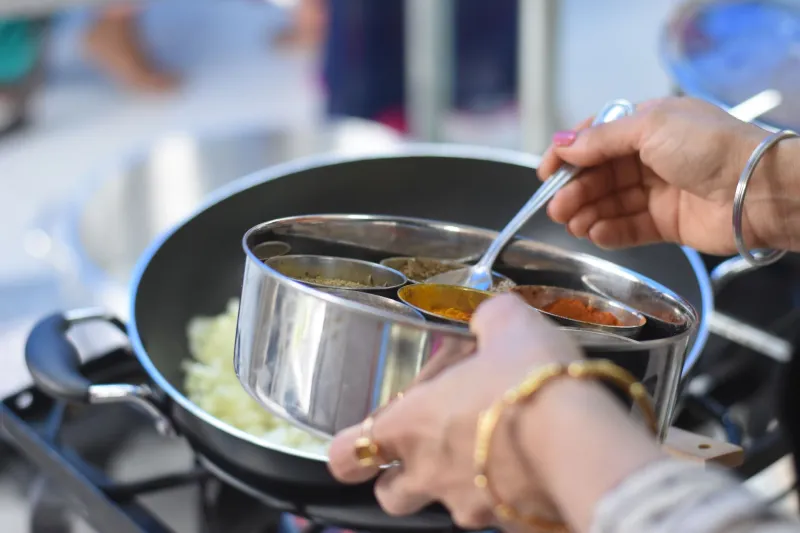
It always starts the same way. You lower the ghee into the pan, the mustard seeds hit the heat, the cumin blooms, the dried chilies begin to char at the edges — and then, right on cue, the smoke detector in your American apartment does what it was built to do. Loudly. Enthusiastically. Without any appreciation whatsoever for what's happening in that pan.
If you've grown up in a Punjabi American household, this is not a crisis. This is Tuesday.
"I have a system," says Gurpreet Sandhu, who cooks out of a two-bedroom apartment in Fremont, California. "Fan on full blast, window open, dish towel on standby. The second I hear the first chirp, I'm already waving. My roommates know what it means. It means dinner's almost ready."
The Physics of Punjabi Food in American Kitchens
Here's the thing that most American kitchen designers did not account for: authentic Punjabi cooking is an aggressive act. It involves high heat, generous amounts of fat, whole spices hitting oil at temperatures that produce visible smoke as a feature, not a bug. A proper tarka — the technique of blooming spices in hot ghee or oil before adding them to a dish — is supposed to look a little dramatic. The smoke is part of the process. It means the spices are doing their job.
American apartment kitchens, on the other hand, were largely designed around a culinary tradition that considers medium heat ambitious. The ventilation hoods are decorative at best. The smoke detectors are positioned with the confidence of someone who has never made saag in their life.
The result is a nationwide pattern of Punjabi American cooks who have become intimately familiar with the architectural limitations of their homes.
"Our stove in Punjab had two burners that could genuinely cook," says Navneet Kaur, who moved to the US from Ludhiana twelve years ago and now lives in a suburb of Chicago. "Here, I have four burners and none of them get hot enough. I have a $400 stove and I feel like I'm cooking on a hot plate. My rotis don't puff the same way. My dal takes longer. Everything is a compromise."
The Workarounds Are Genuinely Impressive
But Punjabi Americans — and really, diaspora cooks broadly — are nothing if not resourceful. Across the country, home cooks have developed a range of creative solutions that deserve more recognition than they typically get.
The garage kitchen is perhaps the most committed adaptation. In Punjabi American communities in the Central Valley, New Jersey, and pockets of Texas and Michigan, it's not uncommon to find a fully equipped second kitchen set up in the garage — complete with a commercial burner, a separate exhaust system, and enough counter space to prep for twenty people without breaking a sweat. This is where the real cooking happens. The indoor kitchen is for heating things up.
"My dad set up the garage kitchen when I was in high school," says Amanpreet Dhaliwal in Stockton. "We have a proper burner out there, a chest freezer, and a table that's been there since 2001. That's where Thanksgiving happens. That's where all the big cooking happens. The inside kitchen is basically for salads."
Other adaptations are more modest but equally clever. Induction burners that can be taken outside. Portable butane stoves set up on back patios. A dedicated "spice fan" — a small box fan pointed out an open window — that gets deployed before the tadka even starts. One home cook in Seattle described rigging a DIY ventilation system using dryer ducting and a box fan that she swears works better than the hood fan that came with her apartment.
The Smoke Detector as a Cultural Artifact
There's something almost metaphorical about the smoke detector situation. It's a device calibrated to one set of culinary norms, struggling to coexist with cooking that operates by a completely different logic. The alarm isn't wrong, exactly — there is smoke. But it's missing the context that makes the smoke meaningful.
Punjabi American cooks have gotten used to translating. Not just their recipes, but their entire cooking environment. Adjusting for lower BTU stoves. Sourcing the right flour for rotis when the local grocery only carries all-purpose. Finding a way to get the right char on a piece of chicken when you don't have access to a tandoor.
"I bought an outdoor pizza oven because it was the closest thing I could find to tandoor heat," admits Rajveer Singh, a home cook in New Jersey who documents his cooking on social media. "I use it for naan, for chicken, for anything that needs that kind of direct high heat. My neighbors think I'm really into pizza. I just let them think that."
The Next Generation Is Adapting Too — But Differently
Younger Punjabi Americans who grew up watching their parents navigate these limitations are approaching it from a different angle. Some are investing in serious kitchen upgrades — commercial-style ranges with real BTU output, quality ventilation hoods, and induction setups they can take outside. Others are leaning into the hybrid: cooking some dishes the traditional way, adapting others for the equipment they actually have.
A few have turned the constraint into creativity. The smoke alarm, in some households, has become a running joke that marks the start of a good meal. The workarounds have become their own kind of tradition — stories told at the dinner table about the time the fan broke mid-tadka, or the landlord who knocked because he thought something was wrong.
"Honestly, at this point the smoke alarm going off is kind of comforting," says Gurpreet Sandhu. "It means we're making real food. The day my kitchen doesn't set it off, I'll know I'm doing something wrong."
He's probably not entirely joking.