Saving Nani's Recipes Before They're Gone: How Punjabi Families Across America Are Racing to Preserve Their Culinary Heritage
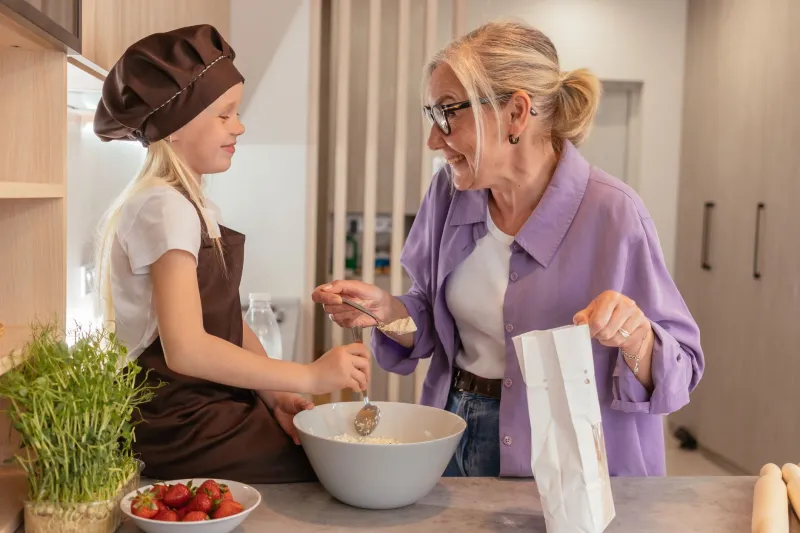
There are no written instructions. No precise measurements. No YouTube tutorials filmed in a tidy kitchen with ring lighting. There's just a pair of weathered hands, a cast-iron karahi, and decades of muscle memory that no algorithm could ever replicate.
For countless Punjabi-American families scattered across cities like Fresno, Houston, Edison, and the suburbs of Chicago, this is the reality of their culinary inheritance. The recipes that define their identity — the ones tied to harvest festivals, wedding mornings, and post-Partition survival — exist almost entirely in the minds and hands of aging grandmothers. And the clock is ticking.
A Heritage Measured in Pinches and Intuition
When Simranpreet Dhaliwal, a 34-year-old software engineer based in San Jose, sat down with her Biji last Thanksgiving, she didn't bring a notebook. She brought her phone, a ring light she borrowed from her teenage daughter, and a quiet urgency she'd been carrying for years.
"Biji doesn't measure anything," Simranpreet laughs. "I asked her how much salt goes into the dal makhani and she literally said, 'enough.' I asked her how long it simmers and she said, 'until it's ready.' I had to just film her hands and figure it out later."
What started as a personal project — a Google Drive folder of shaky videos and voice memos — has since evolved into a family archive spanning four generations. Simranpreet has catalogued over 60 recipes, cross-referencing her grandmother's methods with those of her mother and aunts, noting regional variations that trace back to villages in the Ferozepur district before Partition reshuffled the map of Punjab entirely.
"These aren't just recipes," she says. "They're geography. They're proof that we existed somewhere specific before everything changed."
The Partition Kitchen: Food as Memory and Survival
It's impossible to talk about Punjabi heirloom cooking without acknowledging the seismic rupture of 1947. The Partition of British India forced millions of Punjabis to abandon their homes, their land, and in many cases, their entire material lives. What they carried forward — often across refugee camps, then to cities, then eventually to countries like the United States — was knowledge. Stories. And recipes.
Dr. Harleen Kaur, a cultural historian at UC Davis who studies South Asian diaspora foodways, puts it plainly: "Food became a form of testimony. When you couldn't bring your home with you, you brought the taste of it. Punjabi grandmothers became living archives."
That living archive is now aging. And for families who've been in America for two or three generations, the urgency has never felt more real.
Digitizing Dadi's Kitchen: Three More Family Stories
The Brar Family, Yuba City, CA Yuba City has one of the largest Punjabi Sikh communities outside of India, and the Brar family has been there since the 1970s. When 28-year-old Navneet Brar realized her grandmother's recipe for kheer — a slow-cooked rice pudding made with full-fat milk and cardamom — was subtly different from every version she'd ever tasted elsewhere, she started asking questions. What she uncovered was a technique passed down from her great-grandmother in Jalandhar: reducing the milk for nearly three hours over low heat until it took on a faintly caramel color. "No one else in our family knew why she did it that way," Navneet says. "Now they do."
The Sandhu Family, Naperville, IL For Gurpreet Sandhu, a 41-year-old nurse, the mission became personal after her mother-in-law suffered a stroke. "She couldn't speak clearly anymore, and suddenly all those recipes she'd been meaning to teach me were just... out of reach." Gurpreet worked with a speech therapist and a patient translator to piece together a saag recipe through gestures, written fragments, and old photographs of the family farm in Amritsar. The result is a laminated recipe card that now hangs in her kitchen — and a scanned digital copy stored in three different cloud accounts.
The Gill Family, Fremont, CA Twenty-six-year-old Manpreet Gill went a step further. A graphic design student, she turned her grandmother's recipes into a hand-illustrated zine that she's distributed to relatives across the US, UK, and Canada. "I wanted it to feel like something you'd want to keep," she explains. The zine includes not just recipes but stories — where the dishes were made, what occasions they marked, and what ingredients were substituted during lean times. It's part cookbook, part oral history, part love letter.
Why This Matters Beyond the Kitchen
Food anthropologists and community organizers alike will tell you that culinary preservation is about far more than dinner. When a recipe disappears, so does the context around it — the festivals it fed, the grief it comforted, the celebrations it anchored.
For Punjabi-Americans navigating dual identities, these recipes are a form of cultural citizenship. They connect second-generation kids born in Fremont or Frisco to a Punjab they may have only visited once, or never at all. They give third-generation teenagers something tangible to hold onto when everything else about their heritage feels abstract.
"My daughter grew up on mac and cheese and pizza," says Simranpreet. "But the first time I made Biji's dal the right way — from the video I recorded — she sat down and ate three bowls without saying a word. That silence told me everything."
How to Start Your Own Family Recipe Archive
You don't need a production crew or a culinary degree. Here's how to get started this weekend:
1. Start with a conversation, not a camera. Before you hit record, sit with your elder and just talk. Ask about their earliest food memories, what they cooked during celebrations, what they missed most after moving. Let the stories come naturally.
2. Film the hands, not the face. Close-up footage of hands kneading dough, tempering spices, or shaping rotis captures technique in a way words simply can't.
3. Document the substitutions. Ask what your grandmother used when she couldn't find the original ingredient. These adaptations are their own form of history — and often the most practical information for cooking in America.
4. Cross-reference with relatives. Call aunts, cousins, family friends. Variations matter. They reveal regional roots and personal creativity.
5. Store in multiple places. Google Drive, iCloud, a printed binder, a USB drive at a relative's house. Redundancy is preservation.
6. Share the archive. Whether it's a family group chat, a private Instagram, or a printed zine like Manpreet's, getting these recipes into circulation keeps them alive.
The Bazar Is Open — But Only If We Show Up
Here at Punjab Bazar, we believe that every jar of achaar, every bag of whole spices, every bottle of mustard oil we ship to your doorstep is a small act of cultural continuity. But the recipes that bring those ingredients to life? Those live in people. In grandmothers. In aunties who learned by watching and taught by doing.
The most valuable thing in your Punjabi kitchen isn't anything you can order online. It's a conversation you haven't had yet — and a recording you haven't made.
Don't wait until it's too late to start.