Barfi vs. Buttercream: The Dessert Debate Playing Out at Punjabi American Birthday Tables
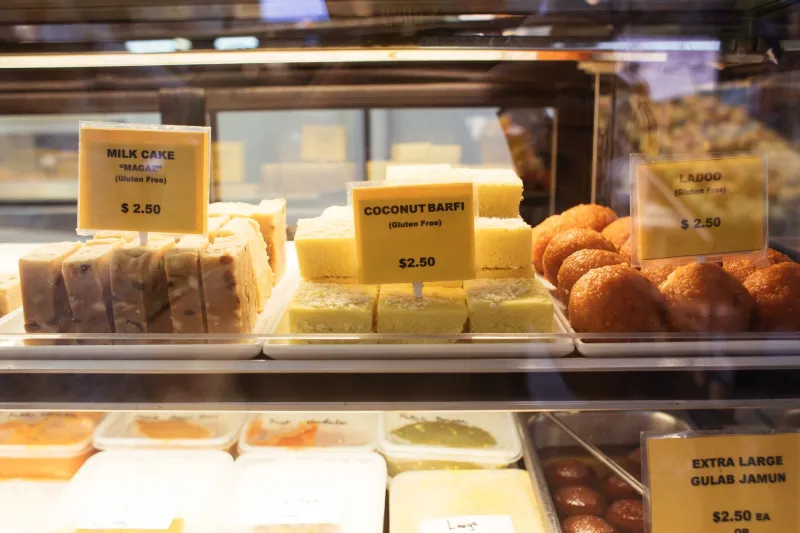
Let's set the scene. It's a birthday party in a Punjabi American household in Edison, New Jersey. The living room is full. Bollywood is playing. There's a table along one wall that holds, simultaneously: a three-tier vanilla cake with whipped cream frosting from the bakery down the street, a box of Haldiram's kaju barfi that the aunty brought because she didn't trust the cake, a tray of gulab jamun that someone's mom made that morning, and — this is the detail that matters — a small plate of cardamom-spiced cupcakes with rose water buttercream that the birthday girl's older sister made herself, from scratch, as a kind of peace offering between two worlds.
This is not unusual. This is, increasingly, the norm.
Two Traditions, One Table
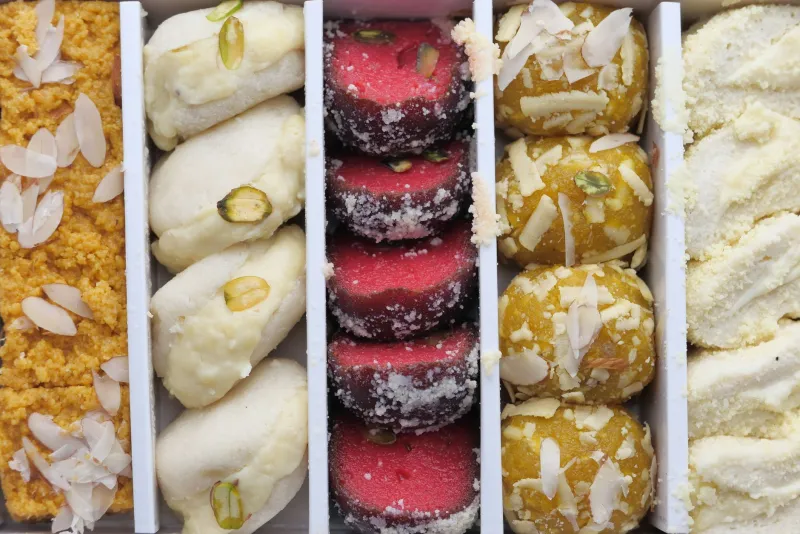
For the first wave of Punjabi immigrants who came to the United States in the 1970s and 80s, the birthday cake was a point of assimilation — something to do for the kids so they didn't feel different at school. You bought a cake from the grocery store, you sang the song, you cut it. The real sweets, the ones that actually meant something, were the mithais: barfi, ladoo, jalebi, peda. Those were for the adults. Those were what you ate at every celebration that actually mattered.
For their children — the second generation who grew up straddling both worlds — neither tradition fully belongs to them or feels complete on its own. The result is a dessert landscape at Punjabi American celebrations that is layered, sometimes chaotic, and genuinely interesting.
"Growing up, I always wanted a birthday cake like my friends had," says Jasleen Bains, a 31-year-old teacher in Fremont, California. "But now that I'm older and I'm the one planning celebrations, I actually want the barfi. I want the halwa. I want the things that feel like my family. It's funny how that flips."
The Aunty Variable
No analysis of Punjabi American dessert culture is complete without acknowledging the aunty factor. In virtually every Punjabi American household, there is at least one older relative — an aunty, a nani, a family friend who might as well be family — who will arrive at any celebration carrying mithai regardless of what has already been arranged. This is not a criticism. This is a service.
The mithai is often homemade. It is often better than anything on the table. It is also non-negotiable.
"My mother-in-law has never, in twenty years, arrived at a birthday party without bringing something she made herself," says Parminder Gill, who lives outside of Chicago. "It doesn't matter if there's already a full dessert table. She brings her besan ladoos. And honestly? Everyone goes for those first."
This creates an interesting social dynamic: the store-bought cake is the official dessert, the one that gets photographed and sung around and cut ceremonially. But the mithai is the one people actually eat. Both serve a purpose. Neither is going anywhere.
The Fusion Generation Steps In
What's newer — and what's generating both excitement and occasional eye-rolls — is the rise of Punjabi American fusion desserts created specifically to bridge the gap. These aren't fusion in the gimmicky sense. They're genuine attempts by younger home bakers and pastry professionals to honor both sides of their culinary identity at once.
Think: cardamom-and-pistachio layer cakes. Gulab jamun cheesecake. Barfi-stuffed donuts rolled in rose petals. Jalebi-inspired swirls piped onto vanilla buttercream. Chai-spiced tres leches that somehow manages to be deeply Punjabi and deeply American at the same time.
"I started baking fusion desserts because I couldn't find what I wanted at any bakery," says Ravneet Kaur, a home baker in the Bay Area who has started taking custom orders. "I wanted something that felt like me — not fully Indian, not fully American, but both. My nani didn't fully get it at first. But then she tasted the cardamom cake and she said, 'okay, this one is good.' That was enough for me."
Regional Punjabi Differences Nobody Talks About
Here's a layer that often gets overlooked in these conversations: Punjab itself is not monolithic when it comes to sweets. Families from Amritsar have different mithai traditions than families from Jalandhar. Families from Ludhiana have different preferences than those from Patiala. And then there's the enormous divide between Indian Punjab and Pakistani Punjab — two communities that share deep culinary roots but have developed distinct sweet traditions over the seventy-plus years since Partition.
In Punjabi American communities, these differences play out quietly but noticeably. The halwa one family considers the essential birthday sweet is completely unfamiliar to the family next door. The particular style of barfi that tastes like home to one household is "not quite right" to another.
"We're not one community with one dessert tradition," points out Manvir Sidhu, a food writer based in New York. "We're dozens of regional traditions that got compressed into 'Punjabi' when we came to America. The birthday dessert question is actually a question about which version of Punjab your family comes from."
What the Dessert Table Actually Means
At its core, the birthday cake standoff — if you can even call it a standoff, given that most tables end up holding both — is a conversation about belonging. About what it means to celebrate in America when your roots are somewhere else. About which traditions you carry forward, which ones you adapt, and which ones you invent from scratch.
The cardamom cupcakes at that birthday party in Edison? They got eaten first. Every last one of them. The aunty who brought the kaju barfi tried one and said it was "interesting" — which, in aunty-speak, is practically a standing ovation.
The cake got cut. The gulab jamuns disappeared. The ladoos went home in little bags as parting gifts.
Everybody ate. Nobody lost.
That, more than any single dessert choice, might be the most Punjabi outcome of all.