Gulab Jamun at a Funeral? Don't Even Think About It: The Unwritten Sweet Rules of Punjabi American Life
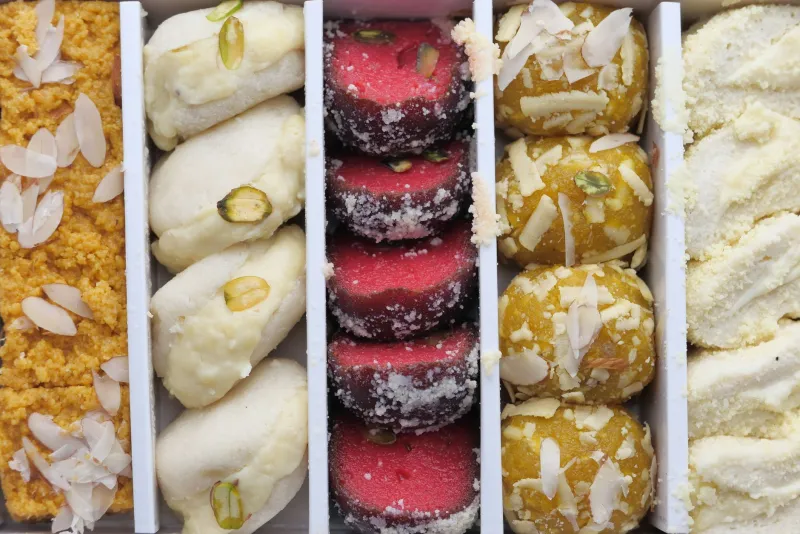
Nobody writes it down. Nobody has to. You just know that showing up to a bhog with a box of gulab jamun is a mistake you will never live down. In Punjabi households across the US, there exists an invisible hierarchy of mithai—a deeply felt, fiercely defended system that assigns specific sweets to specific moments in life. Get it right and nobody says a word. Get it wrong and you become the story at the next gathering.
But here's the thing: not everyone got the same rulebook.
The Map Doesn't Match
Ranjit Gill, who grew up in Ludhiana and now lives in Fremont, California, says the mithai expectations in his household are non-negotiable. "Kheer is for sad occasions. Full stop. If someone brings kheer to a wedding, my mother would think something was wrong." His wife, Simran, who is from Amritsar, had a different upbringing entirely. "We made kheer for everything," she says, laughing. "Birthdays, Diwali, when someone passed their exams. It was the most celebratory thing in our kitchen."
This kind of friction is more common than you'd think. Punjab is not a monolith. Families from the Doaba region, the Malwa belt, and the Majha area often carried slightly different culinary customs with them when they emigrated—and those differences, which might have blurred naturally back home through proximity and shared culture, get preserved in amber here in America. Diaspora life has a way of freezing traditions at the exact moment a family left.
That's how you end up with two Punjabi families living six blocks apart in Fresno who fundamentally disagree about whether barfi belongs at a baby shower.
The Big Occasions and Their Designated Sweets
For all the variation, there are some broad patterns that most Punjabi Americans recognize, even if they debate the details.
Weddings are gulab jamun territory for many families—warm, syrup-soaked, unapologetically indulgent. Some families insist on jalebi as well, specifically the kind that arrives hot and gets eaten immediately, not the sad room-temperature version. "If the jalebi isn't fresh, don't bother," says Harpreet Sandhu, a caterer based in the Chicago suburbs who has been feeding Punjabi wedding guests for over fifteen years.
Births and naming ceremonies often call for ladoo—specifically besan ladoo or motichoor ladoo, depending on who you ask. The ladoo is portable, shareable, and carries a kind of festive sweetness that feels appropriate for new beginnings. Some families distribute boxes of ladoo to neighbors and coworkers when a baby arrives, a tradition that has charmed many a non-Punjabi colleague who had no idea what they were eating but asked for seconds anyway.
Diwali is where things get complicated, because Diwali is essentially an excuse to make all the mithai at once. Families who maintain strict occasion-based rules tend to relax them for Diwali. It becomes a showcase.
Mourning gatherings—the bhog, the antim ardas—are where the rules get most serious and most contested. Kheer appears in many households as a gentle, plain comfort food. Others specifically avoid anything that reads as celebratory. "We don't bring anything sweet to a mourning house," says Gurpreet Kaur of Sacramento. "That's just respect."
When American Holidays Enter the Chat
Then Thanksgiving happened. And Christmas. And Fourth of July potlucks where someone needed to bring dessert and the host didn't want to explain what peda was to their coworkers.
The American calendar has forced a kind of creative renegotiation. Younger Punjabi Americans are increasingly making mithai for occasions that have no Punjabi precedent, and in doing so, they're writing new rules in real time.
Priya Dhaliwal, a second-generation Punjabi American in New Jersey, started making kheer for Thanksgiving about four years ago. "My family thought I was being weird at first," she says. "But it makes sense to me—it's warm, it's comforting, it fits the vibe. Now my mom requests it."
Others are going further. Besan ladoo at Halloween. Barfi at Christmas cookie exchanges. One family in Houston reportedly brought a tray of kalakand to a Super Bowl party and it disappeared faster than the chips.
These aren't violations of tradition so much as extensions of it—a diaspora community doing what diaspora communities have always done, which is adapt without fully letting go.
The Generational Fault Line
The sharpest disagreements tend to run along generational lines rather than regional ones. First-generation immigrants often hold their mithai rules with the same conviction they hold their religious practices—these aren't preferences, they're the way things are done. Second-generation Punjabi Americans, raised between two cultures and often pressed for time, are more likely to ask: does it matter, as long as it's good?
"My mom will spend three days making pinni for a specific relative's visit," says Amrit Brar, who grew up in the Bay Area. "I love that she does it. I also bought a box of mithai from the Indian grocery last week and nobody complained."
Harpreet the caterer has watched this shift play out at hundreds of events. "The elders still care about what's appropriate. The younger generation cares that it tastes good and looks nice on the table. Both things are valid. But they don't always agree."
The Sweet Is Never Just the Sweet
What makes the mithai hierarchy so loaded is that it was never really about the food. It's about memory, about the specific smell of your grandmother's kitchen, about the feeling of being handed a ladoo as a child and knowing exactly what it meant.
When a family argues about whether gulab jamun belongs at a particular gathering, they're actually arguing about belonging—about which version of Punjabi culture gets to be the real one, about who has the authority to set the rules, and about what gets passed on to kids who have never seen the villages these customs came from.
There's no resolution coming. The debates will continue at every gathering, every holiday, every baby shower and bhog. And honestly? That ongoing argument, that insistence on caring deeply about something as specific as which sweet goes where—that's its own kind of cultural preservation.
Bring the kheer. Or don't. Just be ready to explain yourself.