Breaking the Recipe: Young Punjabi Americans Are Cooking Outside the Rules
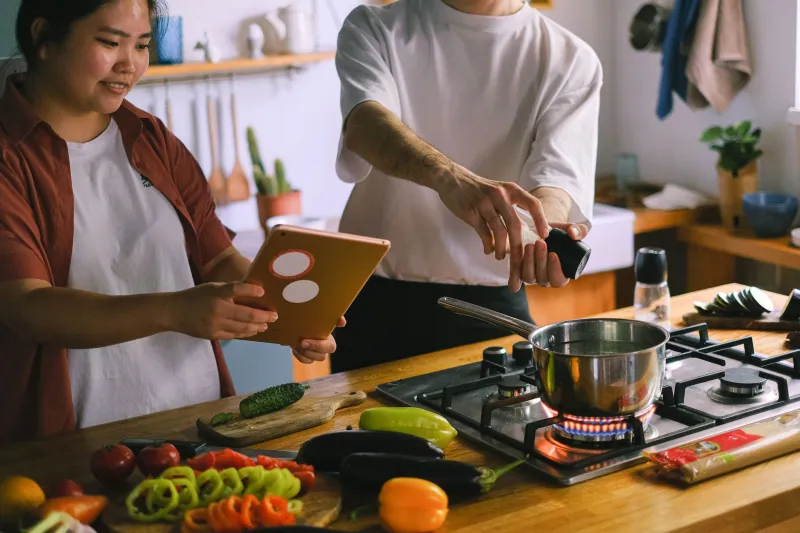
Anjali Dhaliwal is 26 years old, lives in Atlanta, and recently made a lamb keema that her mother has declined to comment on.
It's not that the dish was bad. By all accounts — including Anjali's own, offered with the confidence of someone who has tasted a lot of keema — it was excellent. The problem, from her mother's perspective, was the addition of a Kashmiri-style spice blend that Anjali had researched herself, combined with a cooking technique she'd picked up from a South Indian cooking channel on YouTube. The dish was, in her mother's words, "confused."
Anjali's response: "Yeah, that's kind of the point."
This is what's happening in a growing number of Punjabi American kitchens. A generation of cooks in their 20s and 30s — raised on their parents' food, educated by the internet, and living in American cities with access to every regional Indian ingredient imaginable — are starting to cook in ways that blur, question, and occasionally cheerfully dismantle the culinary boundaries they grew up with.
What Was Off-Limits, and Why
To understand what's changing, you have to understand what was there before.
Traditional Punjabi cooking, like most regional Indian cuisines, operates with a strong sense of internal logic. Certain spices go together. Certain proteins are paired with certain preparations. There are vegetarian traditions that don't mix with meat-based techniques. There are dishes that belong to specific occasions, specific seasons, specific family roles. And there are — spoken or unspoken — rules about what counts as Punjabi food versus what counts as something else entirely.
For first-generation Punjabi immigrants, maintaining those distinctions was often a matter of cultural survival. In a country where "Indian food" was frequently reduced to a single monolithic category, insisting on regional specificity was a form of resistance. You cooked Punjabi food, not just "Indian food," because the distinction mattered. It was identity. It was home.
For their American-born or American-raised kids, the picture is more complicated. They grew up with that same pride in Punjabi food, but they also grew up with the full diversity of American food culture, the internet, food media that celebrates cross-cultural experimentation, and a genuine curiosity about the broader Indian subcontinent that their parents sometimes found threatening.
The Experiments
What does second-generation culinary rebellion actually look like? It's less dramatic than it sounds, and more interesting.
Some of it is regional fusion — Punjabi techniques applied to South Indian ingredients, or vice versa. Priya Sandhu, a 29-year-old home cook in Seattle, has been experimenting with adding curry leaves and mustard seeds to her dal tadka, a combination her Punjabi family considers borderline heretical. "My dad looked at it like I'd committed a crime," she laughs. "But it tasted incredible. Why are we pretending those flavors don't work together?"
Some of it is ingredient expansion. Harjot Singh, 31, grew up in a household where the only acceptable cooking fat was ghee or neutral oil. He now cooks with coconut oil, sesame oil, and occasionally a finishing drizzle of chili oil that he makes himself. His mom has come around on most of it. The chili oil is still under negotiation.
Some of it is about questioning meat hierarchies. Traditional Punjabi cooking has strong preferences around which proteins appear in which contexts. A number of young Punjabi Americans are pushing against this — cooking with lamb, seafood, or even incorporating Korean or Mexican proteins into Punjabi spice frameworks in ways that would make their grandparents' heads spin.
And some of it, perhaps most interestingly, is about bringing back things that got lost. Several young cooks we spoke with have been researching pre-Partition Punjabi food traditions — dishes and techniques that existed before 1947 divided the region and scattered its communities. They're cooking from historical cookbooks, from oral histories, from the food memories of elderly relatives, and recovering recipes that had essentially disappeared from the Punjabi American culinary repertoire.
The Gatekeeping Problem
Not everyone is enthusiastic about this experimentation, and the pushback is worth taking seriously rather than dismissing.
For some first-generation Punjabi Americans, the concern isn't just about culinary purity — it's about erasure. When you've spent decades fighting to be seen as something specific rather than lumped into a generic "Indian" category, watching the next generation blur those distinctions can feel like losing ground. The argument isn't that fusion is bad; it's that fusion without knowledge is just confusion.
"I don't care if my daughter experiments," one mother in the Chicago suburbs told us. "But I want her to know the original first. You have to know the rules before you break them."
That's a reasonable position, and many of the young cooks we spoke with would actually agree with it. The ones doing the most interesting work aren't rejecting Punjabi culinary tradition — they're deeply engaged with it. Anjali, of the controversial keema, has spent significant time learning traditional Punjabi recipes from her grandmother. Her experimentation comes from a place of knowledge, not ignorance.
The conflict, it seems, is less about whether to experiment and more about who gets to authorize the experimentation.
A New Kind of Authenticity
Here's what's genuinely new about this generation's approach to Punjabi food: they're not particularly interested in the question of whether their cooking is "authentic." Not because they don't care about their heritage, but because they've watched that question get used as a gate rather than a guide.
"Authenticity is used to shut people out," says Navneet Kaur, a 27-year-old food blogger based in Houston whose content focuses on Punjabi cooking with a strong experimental streak. "It's used to say your version doesn't count, your experience doesn't count. I'm not interested in that conversation anymore. I'm interested in whether the food is good and whether it means something to me."
What they're building, in kitchens from Atlanta to Seattle to New Jersey, is something that might be called living Punjabi food — a culinary tradition that stays in conversation with its roots while refusing to be frozen by them. It's messier than the version their parents maintain. It's also, arguably, exactly what a living culture is supposed to do.
Anjali's mom still hasn't officially approved of the Kashmiri keema. But she asked for the recipe.