The Langar Effect: How a Centuries-Old Sikh Tradition Is Quietly Changing the Way Americans Share Food
On a Sunday afternoon in Fresno, California, Gurpreet Kaur is standing over a commercial-sized pot of dal makhani, stirring with a wooden spoon the size of a small oar. Her kitchen smells extraordinary. In about two hours, somewhere between forty and sixty people will file through her front door — neighbors, coworkers, strangers referred by strangers, a few folks who saw the open invitation posted in a local Facebook group. Some are Punjabi. Many are not. All of them will eat for free.
"People always ask me why I do this," Gurpreet says, not looking up from the pot. "And I always say — I don't know how to explain langar to someone who hasn't experienced it. You just have to sit down and eat."
What Langar Actually Is — and Why It Matters
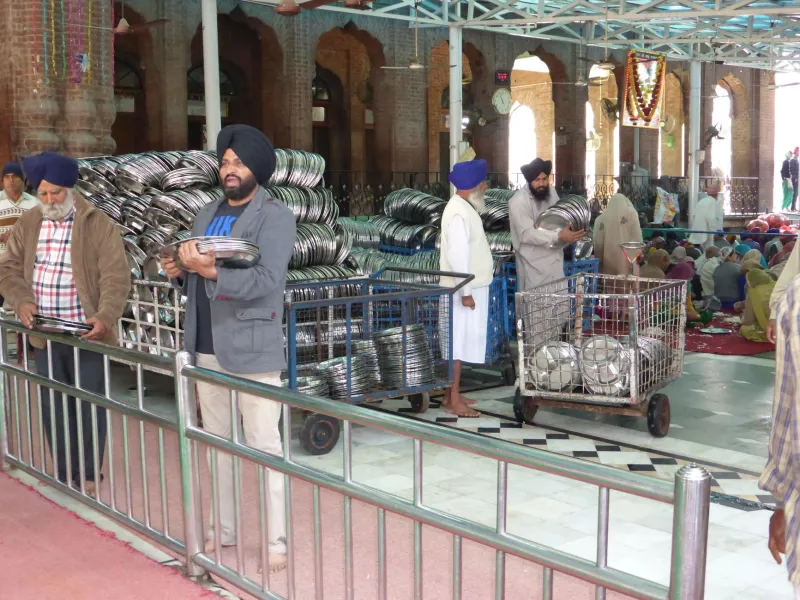
Langar is the practice of the communal kitchen found in every Gurdwara, the Sikh place of worship. Rooted in the teachings of Guru Nanak, the founder of Sikhism, langar was established in the 15th century as a radical act of equality: everyone sits on the floor together, everyone eats the same food, and no one is turned away. Rich, poor, caste, creed — none of it matters at the langar table. The meal is always vegetarian, always free, and always served with what practitioners describe as a spirit of seva, or selfless service.
In India, Gurdwaras serve millions of meals daily. The Golden Temple in Amritsar alone feeds upward of 100,000 people every single day. In the United States, Gurdwaras from Yuba City to New York have been quietly operating community kitchens for decades — often the first responders during local crises, feeding communities after wildfires, floods, and yes, during the early chaos of the COVID-19 pandemic, when Sikh volunteers showed up with hot meals while institutions were still figuring out logistics.
But something is shifting. The practice is moving beyond the Gurdwara walls and into living rooms, community centers, and neighborhood potlucks across the country.
Punjabi Families Taking Langar Into the Neighborhood
Gurpreet's monthly community dinners started small — a few extra plates at a family gathering that kept growing. Now she coordinates with three other Punjabi families in her area, rotating hosting duties and cooking responsibilities. The menu changes, but the principle doesn't: everyone is welcome, no one pays, and everyone helps clean up.
"The cleaning up part is important," she says with a laugh. "That's also seva. You don't just eat and leave."
In Schaumburg, Illinois — a suburb of Chicago with a substantial Punjabi community — a group of families has formalized the arrangement into something they call a "community table," held on the last Saturday of every month at a local community center. What started as a dozen people has grown to regularly drawing over a hundred. The organizers estimate they've served close to 3,000 meals in the past two years.
Organizer Harjinder Singh describes the reaction from non-Sikh neighbors as both heartwarming and a little funny. "People come the first time very confused. They keep asking how much it costs, or what they should bring. We say nothing and nothing. Just come. After the second or third time, they stop asking and they just show up."
Non-Punjabi Americans Catching the Spirit
Perhaps the most striking development in this quiet cultural shift is how the values of langar are resonating with Americans who have no personal connection to Punjabi or Sikh culture at all.
Maria Castellanos, a high school teacher in Sacramento, first encountered langar at a Gurdwara open house organized during a local cultural festival. She left, she says, feeling unsettled in a good way.
"I kept thinking about it for weeks afterward. The idea that you could just feed people — not as charity in a way that makes them feel lesser, but as equals sitting together — it felt like something we've lost in this country. Or maybe never really had."
Maria now hosts a monthly potluck in her home that she half-jokingly describes as "langar-inspired." She asks guests to bring a dish to share and to stay to help clean up. Nobody is required to bring anything if they can't. The gathering has no theme, no dress code, no agenda beyond eating together.
"I can't claim it's langar," she's careful to say. "I'm not Sikh, I'm not Punjabi, and I don't want to take something that belongs to another community and call it my own. But it inspired me. There's a difference."
That distinction — inspiration versus appropriation — is one that Punjabi and Sikh community members navigate thoughtfully. Most people interviewed for this piece expressed genuine warmth toward non-Punjabi Americans embracing communal meal-sharing values, while noting that the full spiritual and cultural context of langar is specific to the Sikh faith and shouldn't be flattened into a lifestyle trend.
"If learning about langar makes your neighbor want to feed people — great," says Harjinder. "We just ask that people understand where it comes from and why. It's not a brunch concept. It's a spiritual practice that has fed the hungry for five hundred years."
Why This Moment, Why America
Food sociologists and cultural commentators have noted that interest in communal eating practices has surged in the US over the past decade, coinciding with rising rates of reported loneliness, eroding civic trust, and a growing hunger (literal and figurative) for meaningful human connection.
The langar model — radically inclusive, expectation-free, nourishing in every sense of the word — offers something that trendy dinner party concepts and curated food experiences often don't: genuine equality at the table. You're not there because you RSVPed on an app or paid a ticket price. You're there because you're a person and there's food.
For Punjabi diaspora communities in the US, seeing these values recognized and appreciated by their neighbors carries its own particular meaning. It's a form of cultural visibility that doesn't require explanation or performance — just a bowl of dal and a seat on the floor.
Bringing It Home
Back in Gurpreet's kitchen in Fresno, the dal is nearly ready. Someone has arrived early and is already washing dishes. A neighbor has dropped off a tray of mithai she made that morning. Kids are setting up folding tables in the living room.
Gurpreet tastes the dal, adjusts the salt, and nods to herself.
"In Punjab, we say the Gurdwara's door is always open," she says. "Here, my door is always open. Same idea, different address."
Some traditions travel better than others. This one, it turns out, travels beautifully.