Crispy, Stuffed, and Deeply Personal: The Great Punjabi American Samosa Debate
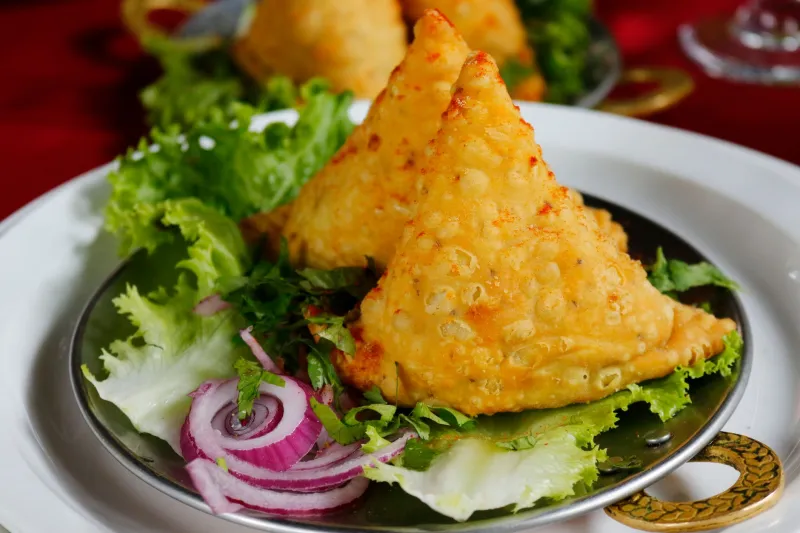
It starts innocently enough. Someone posts a photo in a Punjabi diaspora Facebook group — a plate of golden, freshly fried samosas, steam curling off the tips. Within minutes, the comments section looks less like a food appreciation thread and more like a courtroom.
"Why is the fold so thick?" "You used peas? My nani would cry." "That's not a samosa, that's a triangle pocket of lies."
Welcome to the samosa wars. If you're Punjabi American, you already know exactly what we're talking about.
A Snack With a Thousand Opinions
The samosa is arguably the most iconic item in the South Asian snack canon. It shows up at every desi party from Fremont to Flushing, gets sold at every Indian grocery store from Houston to Chicago, and has somehow also landed on the menus of American sports arenas and airport food courts. But for Punjabi families who carry their own specific version of this pastry in their muscle memory, those mass-produced triangles can feel like a distant, disappointing cousin.
Because here's the thing: there is no single samosa. Not even close.
Across Punjab — both the Indian and Pakistani sides — samosa traditions vary dramatically by region, by family, and sometimes by neighborhood. What counts as the "correct" filling, the "proper" dough thickness, the "right" oil temperature, and even the acceptable geometry of the fold are all deeply held convictions passed down through generations. Bring those convictions to America and you've got yourself a snack with serious identity politics baked right in.
The Fold Is Not a Small Thing
Let's start with structure, because for a lot of Punjabi home cooks, the fold is everything.
The classic samosa shape — that distinctive cone sealed into a triangle — requires making a cone from a rolled dough circle, stuffing it, and then sealing the open end with a series of pleats. Simple in theory. A complete personality test in practice.
Some families swear by a single, clean pleat pressed flat. Others do a multi-fold crimped edge that looks almost like a braid. There are households where the dough is rolled paper-thin for maximum crunch, and others where a thicker shell is considered more honest, more satisfying — more real.
"My mom always said the fold tells you everything about who taught someone to cook," says Parveen, a home cook in the Bay Area whose family is originally from Jalandhar. "When I see a samosa with a sloppy seal, I think about how that filling is going to leak into the oil and I physically wince."
The seal isn't just aesthetic. A poorly folded samosa falls apart in the fryer. A properly constructed one holds its shape, cooks evenly, and delivers that satisfying crunch on the first bite. The fold, in other words, is load-bearing.
Aloo vs. Keema: The Filling Fault Line
If the fold is a technical debate, the filling question is an emotional one.
In many Indian Punjabi households, the default samosa filling is aloo — spiced potatoes, sometimes with green peas, spiked with cumin, coriander, dried mango powder, and green chili. It's vegetarian, it's filling, and it's what most people picture when they hear the word samosa.
But cross over into Pakistani Punjabi tradition and the keema samosa — ground meat, usually beef or lamb, cooked down with onions and spices — is equally, if not more, central. For Pakistani American families from Lahore or Faisalabad, offering someone an aloo samosa when they were expecting keema is a genuine disappointment.
"I grew up eating keema samosas at every family gathering," says Tariq, who moved from Lahore to Dallas in his twenties. "When I first went to an Indian friend's place and they brought out potato ones, I was polite but honestly confused. It felt like someone served me a hot dog without the hot dog."
This divide tracks along religious and regional lines, but it doesn't stay neatly contained. Plenty of Indian Punjabi families make meat samosas too. Some households do both, keeping them on separate trays so nobody has to ask awkward questions. And then there are the fusion experimenters — Punjabi Americans who stuff their samosas with everything from spiced lentils to leftover chicken tikka to a mixture that somehow involves cream cheese — who manage to offend everyone equally and don't particularly care.
The Oil Question Nobody Wants to Answer
Deep frying samosas is not complicated. It is also, apparently, extremely complicated.
Oil temperature is a point of genuine contention. Fry too hot and the outside burns before the dough cooks through. Too cool and you get a greasy, pale result that sits heavy in your stomach. The window of correctness is narrow and fiercely guarded.
Then there's the oil itself. Traditionally, samosas were fried in desi ghee or mustard oil — both of which produce a flavor profile that vegetable oil simply cannot replicate. In American kitchens, most home cooks default to canola or sunflower oil for practical reasons, but the old-timers in the family will tell you, every single time, that it's just not the same.
"My dad refuses to eat my samosas," laughs Simran, a second-generation cook in New Jersey. "Not because they taste bad — my friends love them — but because I'm not using the right oil. He says it's 'missing something.' I think that something is 1970s Punjab and there's no oil that's going to fix that."
What We're Really Arguing About
Here's the thing about the samosa debate that goes deeper than dough thickness and frying temperatures: it's really a conversation about belonging.
For first-generation Punjabi Americans, the samosa they grew up with is a fixed point — a sensory anchor to a place and a time that no longer exists in the same form. Defending that version isn't stubbornness. It's preservation. Every insistence on the "right" fold or the "correct" filling is a small act of holding on.
For second and third-generation cooks, the samosa is more fluid. It's something they learned from a parent or a YouTube video or a combination of both, adapted to what's available at the local Indian grocery store or Whole Foods. Their version is also real. It's just real in a different way.
What both generations share is the conviction that the samosa matters — that it's worth arguing about, worth getting right, worth passing down. In a diaspora community that is constantly negotiating what to keep and what to let go, the fact that people are still fighting about pleat technique is, honestly, kind of beautiful.
Make Your Own Call
There is no official ruling on the correct samosa. There will never be one. The arguments will continue in comment sections and family WhatsApp groups and across kitchen counters in cities across America for as long as Punjabi families are frying things together.
What we'd suggest? Make the version your family makes. Defend it warmly and without apology. Try someone else's version with genuine curiosity. And if you happen to be at a party where both aloo and keema samosas are on offer, take one of each.
That, at least, is something everyone can agree on.